Peptides vs. HGH: What's Legal, What Works, and What's Marketing
By Bryce Johnson ·

If you've searched for ways to feel stronger, recover faster, or lose stubborn belly fat, you've probably run into two very different-sounding options: HGH and growth hormone peptides. They get lumped together in marketing, but peptides vs HGH is really a question about two different mechanisms, two different legal categories, and two very different evidence bases. Below, we break down the mechanical difference, what's actually legal, what the research supports, and how our nurse practitioners in Meridian, Twin Falls, and Lewiston, Idaho think through the growth-hormone axis with patients.
The Mechanical Difference: Replacing vs. Signaling
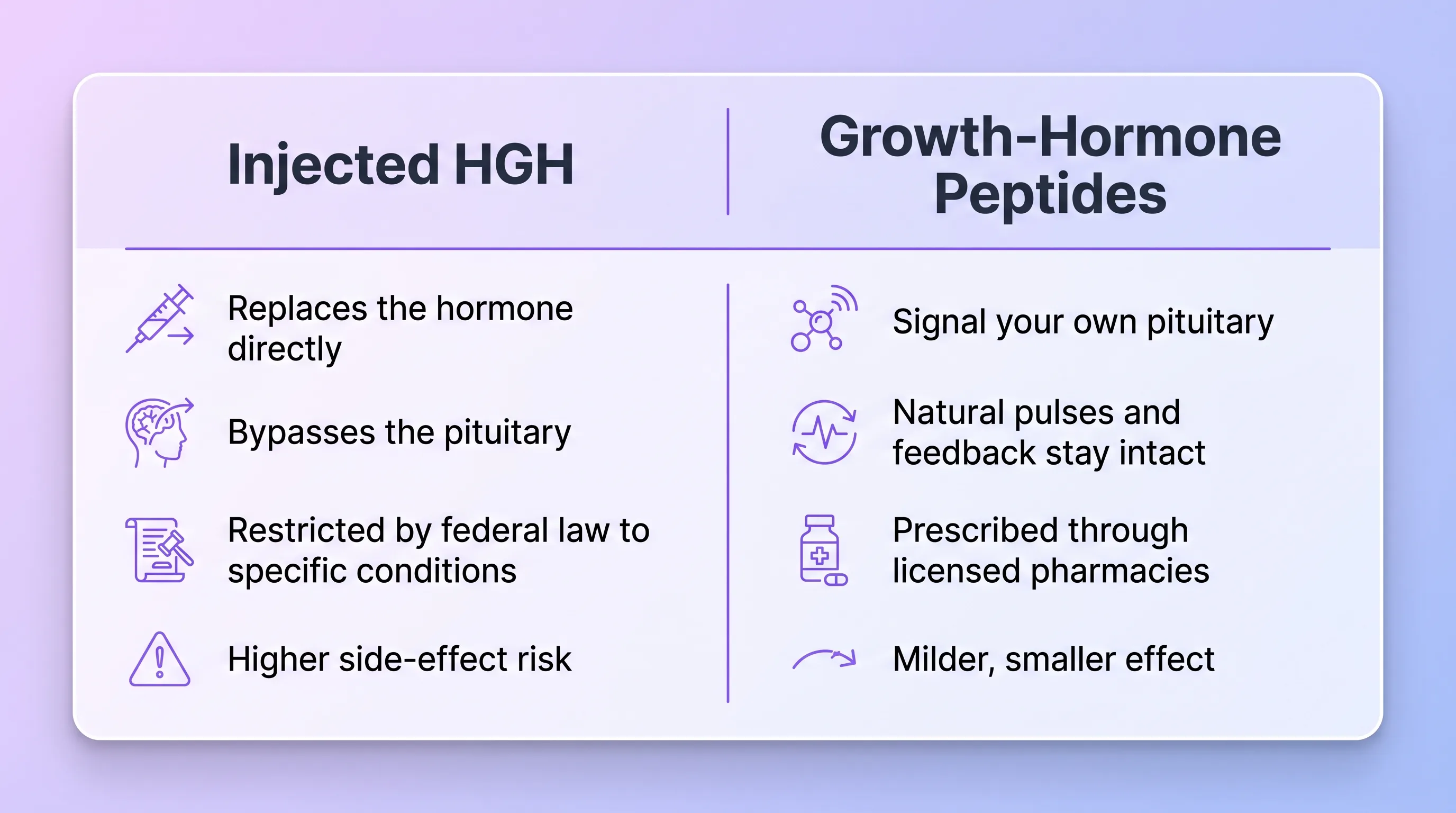
HGH replaces growth hormone directly; growth hormone peptides signal your own pituitary to release more of it. That distinction drives almost everything else in this comparison — legal status, side-effect profile, and how each is monitored.
HGH is recombinant somatropin, a lab-made copy of the hormone itself, given by injection. It bypasses the pituitary gland entirely, so it produces a sustained, supraphysiologic (higher than the body would naturally produce) level of growth hormone, without the pulsatile rhythm or the feedback control your body normally uses to keep hormone levels in a safe range.
Growth hormone peptides — sermorelin, CJC-1295, ipamorelin, and tesamorelin, sometimes called growth hormone secretagogues — work upstream. They prompt the pituitary to release the body's own growth hormone, mostly during deep sleep, in its normal pulsed pattern. Because the signal still runs through the pituitary, your body's negative feedback loop stays intact — there's a built-in ceiling. That also means secretagogues only work if the pituitary can still respond; they are not a treatment for true pituitary failure, where the gland itself cannot produce growth hormone no matter how strongly it's signaled.
What's Legal in the United States
HGH carries federal criminal restrictions that growth hormone peptides do not. Under 21 U.S.C. § 333(e), distributing or possessing HGH for any use other than an FDA-authorized condition is a felony — HGH is one of the very few drugs in the country with that level of legal exposure for off-label use.
The FDA-authorized adult uses of HGH are narrow: documented adult growth-hormone deficiency confirmed by stimulation testing, HIV-associated wasting, short bowel syndrome, and a short list of other specific conditions. Anti-aging, athletic performance, and general wellness are not authorized uses. If a clinic offers HGH "for anti-aging" or "to feel younger," it's describing something that isn't lawful — that's worth knowing before you consider it, not after.
Peptides sit in a different, more nuanced category. Tesamorelin (brand name Egrifta) is FDA-approved to reduce excess abdominal fat in HIV-associated lipodystrophy, and is used off-label for visceral fat in other patients. Sermorelin had an FDA-approved product (Geref) in the 1990s, discontinued for commercial reasons rather than safety, and it's commonly prescribed today through licensed compounding pharmacies. CJC-1295 and ipamorelin were removed from the FDA's restricted-compounding list in April 2026, following an HHS announcement in February 2026, which means licensed pharmacies can compound and dispense them where state law permits — though neither is FDA-approved, and ipamorelin acetate remains restricted for larger 503B outsourcing facilities. Availability for compounded peptides changes as FDA compounding rules evolve, so what's confirmed at your consultation is what actually applies.
Side Effects and Risk: HGH vs. Secretagogue Peptides
The core risk difference follows directly from the mechanism: HGH has no natural ceiling because it bypasses the pituitary, while secretagogue peptides are limited by how much your own gland can produce. That makes HGH's excess-related side effects more pronounced and more common at typical off-label doses.
With HGH in excess, patients can experience fluid retention, joint pain, carpal tunnel syndrome, insulin resistance or new-onset diabetes, and — with long-term excess — changes to heart structure. Secretagogue peptides tend to produce milder effects: injection-site reactions, transient flushing, water retention, and for ghrelin-mimetic peptides like ipamorelin, increased appetite. The smaller, slower rise in IGF-1 (the hormone growth hormone signals through) is the reason the side-effect profile is generally gentler.
| HGH (somatropin) | Secretagogue peptides (sermorelin, CJC-1295, ipamorelin, tesamorelin) | |
|---|---|---|
| What it is | The growth hormone itself, injected directly | Signals the pituitary to release your own growth hormone |
| How it acts | Bypasses the pituitary; sustained, non-pulsatile levels | Works through the pituitary; preserves natural pulses and feedback |
| Legal status | Felony to distribute/possess for non-FDA-authorized use (21 U.S.C. § 333(e)) | Off-label prescribing through licensed compounding pharmacies; not a controlled substance |
| Side effects | Fluid retention, joint pain, carpal tunnel, insulin resistance, possible cardiac changes with long-term excess | Injection-site reactions, flushing, water retention, appetite changes (ipamorelin) |
| Evidence | Strong in confirmed deficiency; weak and mixed for anti-aging in healthy adults | Strongest for tesamorelin's approved use; smaller studies for others |
| Shared cautions | Active malignancy; caution with uncontrolled diabetes and proliferative retinopathy | Same |
What the Evidence Actually Supports
The strength of the evidence for either HGH or peptides depends heavily on who's taking them — adults with a confirmed growth-hormone deficiency see clear benefit, while healthy adults chasing anti-aging effects are working with a much thinner and more mixed evidence base.
In adults with confirmed growth-hormone deficiency, replacement therapy improves body composition, bone density, lipid profiles, and quality of life — that's well established in the Endocrine Society's clinical practice guideline on adult GH deficiency (Molitch et al., 2011). That's the population HGH was built for.
The picture is more nuanced in healthy older adults without deficiency. A systematic review published in Annals of Internal Medicine (Liu et al., 2007) found modest improvements in lean and fat mass, alongside a higher rate of side effects like soft-tissue edema, joint pain, and glucose intolerance than researchers wanted to see for otherwise-healthy adults. That trade-off — real but modest body-composition change paired with a higher side-effect load from sustained, non-pulsatile HGH dosing — is exactly why clinicians who work in this space tend to favor secretagogue peptides instead: they nudge the body's own growth-hormone rhythm rather than overriding it.
Among the peptides, tesamorelin has the strongest human data in its approved use: a trial published in the New England Journal of Medicine (Falutz et al., 2007) showed roughly a 15% reduction in visceral adipose tissue over 26 to 52 weeks, with fat returning after the medication was stopped. Sermorelin, ipamorelin, and CJC-1295 in healthy adults are mechanistically sound — the biology makes sense, and they work with the pituitary's natural pulsed rhythm — though the supporting studies are smaller than the large HIV-lipodystrophy tesamorelin trials.
What patients on sermorelin or CJC-1295/ipamorelin commonly report: better sleep quality, faster recovery between workouts, and easier body-composition changes over several months of consistent use, alongside their broader hormone and lifestyle plan. Every patient's timeline and degree of change is different, and a provider sets expectations based on your labs and goals rather than a standard script.
Peptides vs. HGH for Anti-Aging: What's Marketing
Here's the honest version of what "peptides vs HGH for anti-aging" actually means in 2026: neither is an approved anti-aging treatment, so a clinic's real value is helping you weigh the trade-offs honestly rather than promising a specific outcome. The Endocrine Society-reviewed benefits of growth hormone are strongest for people with confirmed deficiency, and the Annals of Internal Medicine review found the body-composition trade-offs less favorable for healthy older adults using HGH. Sermorelin, CJC-1295, and ipamorelin can be reasonable off-label options in the right patient after the right workup, and many patients notice the sleep and recovery benefits described above — results still vary person to person, and no provider can promise a specific outcome in advance.
What's marketing versus what's medicine usually comes down to the claim being made. "This peptide can help support your body's own growth-hormone signaling, and here's what the evidence realistically shows" is a medical framing. "This will melt fat and turn back the clock" is a sales pitch — for either category.
How We Think About It at Our Idaho Clinics
At Hormones + Weight Loss, growth-hormone signaling is rarely the first lever we reach for. Fatigue, poor recovery, midsection fat, and lost strength are more often driven by sex-hormone decline, insulin resistance, low protein intake, insufficient resistance training, and short sleep — issues that are cheaper to address, better evidenced, and safer to start with than anything that touches the growth-hormone axis.
If those foundations are addressed and a growth-hormone-axis question remains, our nurse practitioners work from labs, not assumptions: IGF-1, a fasting metabolic panel with glucose and A1c, a full hormone panel, and stimulation testing where indicated. From there, peptide therapy — most often sermorelin, CJC-1295/ipamorelin, or tesamorelin — is discussed as one option among several, alongside bioidentical hormone therapy and progress tracked with InBody body-composition scans. This is nurse-practitioner-led, labs-first care across our Meridian clinic and our Twin Falls and Lewiston locations — not a one-size-fits-all protocol.
What patients tell us: Patients who start a growth-hormone secretagogue after this kind of workup commonly describe deeper, more restorative sleep within the first few weeks, quicker bounce-back after workouts, and steadier progress on body-composition goals over the following months. As always, results vary by individual, and our nurse practitioners set expectations based on your specific labs rather than a general timeline.
Frequently Asked Questions
Is HGH legal for anti-aging?
No. HGH's FDA-authorized adult uses are limited to confirmed growth-hormone deficiency, HIV-associated wasting, short bowel syndrome, and a few other specific conditions. Distributing or possessing HGH for anti-aging, athletic performance, or general wellness is a federal offense under 21 U.S.C. § 333(e), regardless of how it's marketed.
Are peptides safer than HGH?
Growth hormone peptides generally carry a milder side-effect profile because they work through the pituitary's own feedback loop, which caps how much hormone your body produces. HGH bypasses that loop entirely, so excess-related risks like fluid retention, joint pain, and insulin resistance tend to show up more at typical off-label doses. Peptides still have their own cautions, particularly around active malignancy and blood sugar.
Which growth hormone peptide has the best evidence?
Tesamorelin has the strongest clinical trial evidence among the growth hormone peptides, with randomized trials showing measurable visceral-fat reduction in its FDA-approved use for HIV-associated lipodystrophy. Sermorelin, CJC-1295, and ipamorelin are mechanistically sound and widely used off-label, with patients commonly reporting better sleep and recovery; the formal trial base for those benefits is still smaller than tesamorelin's.
Do I need testing before starting?
Yes. A responsible starting point includes IGF-1, a fasting metabolic panel with glucose and A1c, and a full hormone panel, with stimulation testing where indicated. This confirms whether your pituitary can actually respond to a secretagogue and rules out contraindications like active cancer or uncontrolled diabetes before anything is prescribed.
Can I get sermorelin in Meridian, Twin Falls, or Lewiston?
Our nurse practitioners discuss sermorelin and other growth hormone peptides at all three Idaho locations — Meridian, Twin Falls, and Lewiston — with Boise-area patients typically seen in Meridian. Availability depends on current compounding rules and your individual labs, which is why it starts with a consultation rather than a standing prescription.
The Takeaway
Peptides vs HGH isn't really a question of which one is "better" — it's a question of mechanism, legal status, and evidence, and the two categories differ on all three. HGH replaces growth hormone directly and carries serious legal restrictions outside confirmed deficiency; growth hormone peptides signal your own pituitary and sit in a more flexible, off-label prescribing space with generally milder effects. Either way, the growth-hormone axis is rarely the right place to start — foundations like sleep, protein, training, and other hormones usually matter more. If you're curious whether peptide therapy fits your situation, book a consultation with our nurse practitioners to talk through your labs and goals.


