
Low Testosterone in Women: Signs, Symptoms, and Treatment Options
By Bryce Johnson ·

If you've been told your labs are "normal" while you feel exhausted, foggy, and unlike yourself, you are not imagining it — and you are not alone. Low testosterone in women is a real, well-documented condition that has been underdiagnosed for decades, in part because testosterone was long treated as "a male hormone" and largely ignored in women's health research. It isn't. Testosterone is a normal, essential hormone in the female body, and when it declines, the effects on energy, libido, mood, and strength are just as real as any other hormone imbalance. This guide explains what testosterone actually does for women, why it drops, the signs of low testosterone in women that get missed most often, why standard testing so often misses it, and what treatment looks like when a provider takes your symptoms seriously.
Why Low Testosterone in Women Has Been So Often Missed
Low testosterone in women has been under-recognized because testosterone research has historically centered on men, and because standard lab testing wasn't built to measure the low concentrations typical in the female body. That gap has left many women without answers for years.
The history matters here. After the Women's Health Initiative study results were released in 2002, headlines about hormone therapy risk spread faster than the nuance behind them. Hormone prescribing for women collapsed almost overnight, and a generation of women were steered away from treatment based on a risk picture that later reanalysis substantially revised. Testosterone, which had never been the focus of that study to begin with, got swept into the same retreat. The result: many women who brought real, disruptive symptoms to a provider were told their bloodwork looked fine and that what they were feeling was just stress, aging, or "normal for your age." For a lot of women, it wasn't. It was low testosterone in women going unrecognized while research played catch-up to what patients were already experiencing.
What Testosterone Actually Does in the Female Body
Testosterone in women is produced in the ovaries, the adrenal glands, and fat tissue, and it plays a direct role in libido, energy, muscle strength, bone density, mood, and mental sharpness. Women naturally produce far less testosterone than men, but the female body is highly sensitive to changes in it — a modest drop can produce symptoms that feel anything but modest.
This is one of the more overlooked facts in women's hormone health: testosterone isn't a "bonus" hormone that only matters for building muscle. It works alongside estrogen and progesterone in a system that supports how you think, how you feel, how your body responds to exercise, and how interested you are in sex. When testosterone drops out of that system, the effects tend to show up across several areas of life at once, which is exactly why symptoms of low testosterone in women often get chalked up to "everything at once" rather than one identifiable cause.
Signs and Symptoms of Low Testosterone in Women
The most common signs of low testosterone in women cluster around low sex drive, persistent fatigue, and a noticeable drop in physical resilience — often alongside mood changes that don't fully resolve with sleep or stress management. Low testosterone symptoms in female patients are easy to dismiss individually because they overlap with perimenopause, thyroid issues, and everyday burnout, but together they form a pattern worth paying attention to.
Common symptoms include:
- Low libido or loss of sexual desire — often the most specific symptom, sometimes described clinically as hypoactive sexual desire disorder (HSDD), a persistent, distressing lack of sexual interest
- Persistent fatigue that doesn't improve with rest
- Reduced muscle strength and tone, even with consistent exercise
- Difficulty maintaining bone density
- Brain fog — trouble concentrating, word-finding difficulty, mental sluggishness
- Low mood or flattened motivation that feels different from typical stress
- Reduced overall sense of well-being or vitality
| Symptom | May relate to |
|---|---|
| Low libido / low desire | Testosterone, estrogen, relationship or life stress, thyroid |
| Persistent fatigue | Testosterone, thyroid, adrenal function, sleep, iron |
| Reduced muscle strength | Testosterone, estrogen, activity level, protein intake |
| Brain fog | Testosterone, estrogen, thyroid, sleep quality, perimenopause |
| Low mood | Testosterone, estrogen, progesterone, thyroid, life circumstances |
No single symptom on that list proves low testosterone in women on its own — that overlap is precisely why an experienced provider evaluates the whole picture rather than chasing one symptom in isolation. If several of these sound familiar, the hormone assessment quiz is a low-friction first step to organize what you're noticing before you ever sit down for labs.
What Causes Low Testosterone in Women
Low testosterone in women is most commonly driven by age-related decline, surgical removal of the ovaries, or medications — especially oral estrogen and oral contraceptives — that reduce how much usable testosterone is circulating in the body, even when total hormone levels appear normal.
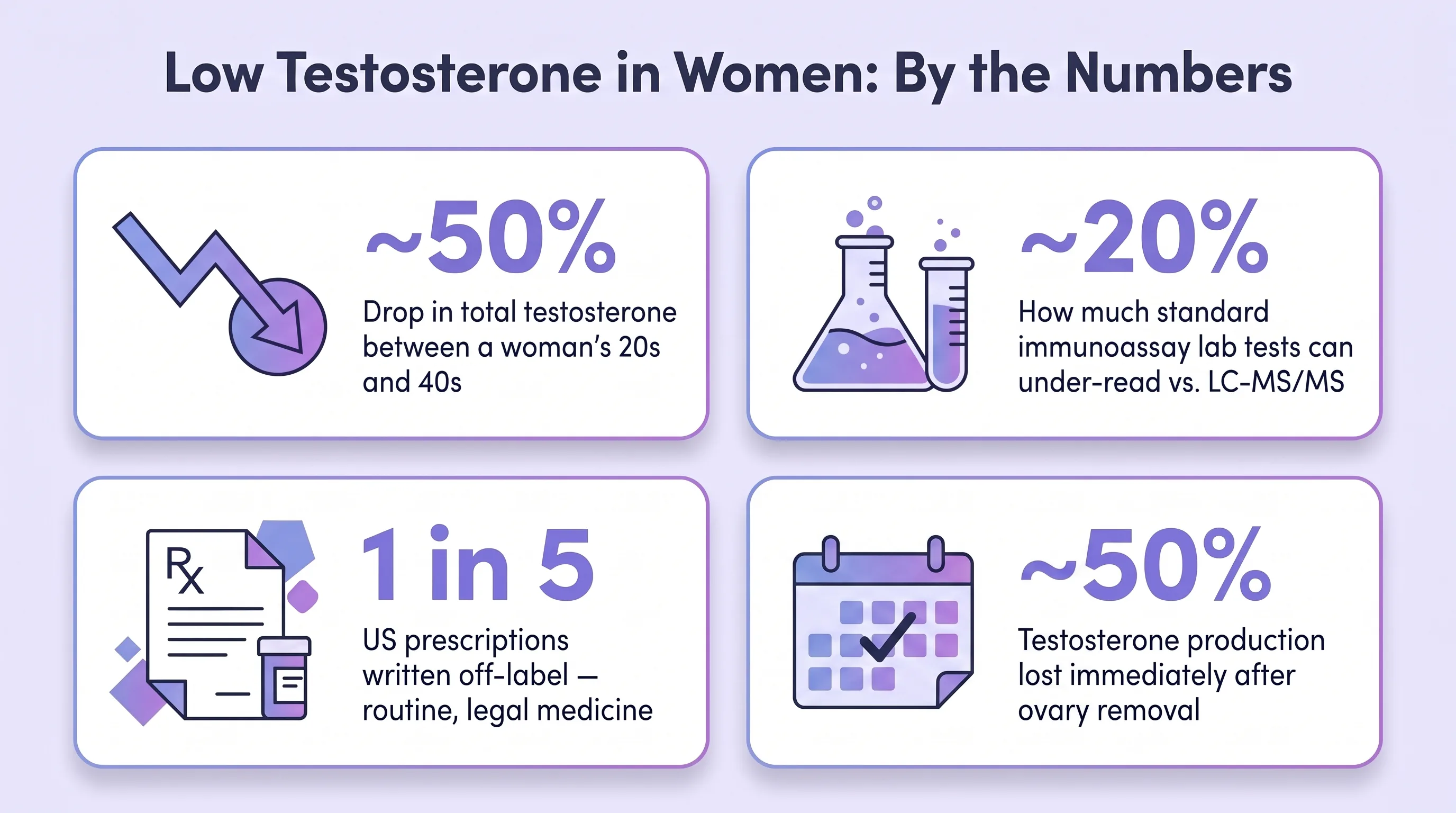
Age-related decline. Total testosterone in women falls roughly 50% between the 20s and 40s. Interestingly, 2025 research out of Monash University (led by Professor Susan Davis) found that this decline tracks with age itself, not with the menopause transition — levels tend to plateau in the years around menopause and may even tick up slightly after roughly age 58–59. That's a counterintuitive but important finding: the drop that leaves so many women symptomatic in their 30s and 40s is happening well before menopause, which is exactly the window when "your labs are normal, you're just getting older" gets said the most.
Oophorectomy. Surgical removal of the ovaries removes roughly half the body's testosterone production almost immediately, since the ovaries are one of the two primary production sites (along with the adrenal glands).
Oral estrogen and oral contraceptives. This is one of the least-explained mechanisms in women's hormone health, and it deserves more attention than it usually gets. Oral estrogen therapy raises sex hormone-binding globulin (SHBG) — a protein that binds to testosterone in the bloodstream. When SHBG rises, more testosterone gets bound up and unavailable, which lowers free testosterone — the usable, biologically active fraction — even when total testosterone on a lab report looks perfectly normal. Oral contraceptives raise SHBG the same way. This single mechanism explains a huge number of "my labs are normal but I feel terrible" conversations, and it's a detail almost never discussed outside of a specialty hormone consultation.
Other medical causes. Adrenal insufficiency, hypopituitarism, chronic corticosteroid use, and chemotherapy can all suppress testosterone production or availability.
Why Standard Testing Often Fails Women
Standard testosterone testing often fails women because the most common lab method — immunoassay — was designed for the much higher concentrations found in men and becomes unreliable at the lower concentrations typical in the female body.
A comparative study found immunoassay testosterone results running roughly 20% lower than the more precise LC-MS/MS method, with poor correlation between the two below 100 ng/dL — precisely the range where most women's results fall. LC-MS/MS (liquid chromatography–tandem mass spectrometry) is a laboratory method that separates and measures hormone molecules with far greater precision, and it's considered the more accurate approach for testing testosterone in women. If you're getting tested, it's worth simply asking your lab which method they use — that single question is one of the most genuinely empowering things a woman can do before drawing any conclusions from a testosterone panel.
A few other testing details matter:
- Free testosterone plus SHBG tell a more complete story than total testosterone alone, especially if you're on oral estrogen or birth control.
- Morning blood draws matter, since testosterone follows a diurnal (daily) rhythm and tends to be highest earlier in the day.
- There's no single universal cutoff that defines "low" for every woman. Reference ranges vary, and a number that falls "in range" can still be low for you relative to your symptoms and history.
That last point isn't a limitation — it's exactly why the right provider matters more than the number on the page. A good provider treats the patient and the symptom pattern in front of them, not just a lab slip. Research in women's hormone health is still catching up to what experienced clinicians see in practice every week, and that gap is worth naming honestly rather than glossing over.

How Low Testosterone in Women Is Diagnosed and Treated
Diagnosing low testosterone in women starts with a real conversation about symptoms, a careful history (including any oral estrogen or birth control use), and testing that includes free testosterone and SHBG — ideally via LC-MS/MS rather than standard immunoassay. Treatment, when appropriate, is individualized and monitored rather than one-size-fits-all.
A quick, honest note on regulatory context: testosterone therapy is not FDA-approved specifically for women. That doesn't mean it's unusual or off the table — it means it's prescribed off-label, which is routine, legal medicine. Roughly one in five prescriptions written in the United States is for an off-label use, and off-label prescribing is a normal part of how providers tailor treatment to patients whose needs don't fit a pre-approved label. For testosterone in women, that typically means reduced-dose transdermal formulations or compounded preparations — including pellet options — dosed specifically for the female body rather than repurposed male dosing. This is where bioidentical hormone therapy (often shortened to BHRT, meaning hormones that are molecularly identical to what your body already produces) comes in: testosterone prescribed this way is compounded or formulated to match your body's own chemistry rather than a synthetic analog.
The goal of testosterone replacement therapy for women using bioidentical hormone therapy is to bring levels into a healthy premenopausal female range and then monitor and adjust from there. That's an ongoing process, not a one-time prescription: follow-up labs, symptom check-ins, and dose adjustments as needed. Many women report noticing changes in energy, mood, and libido as levels normalize, though — like any hormone therapy — individual response varies and results aren't guaranteed.
A Note on Side Effects
Because testosterone dosing for women is more art than a fixed formula, side effects like acne or unwanted hair growth can occur — and they're typically dose-related and manageable with adjustment rather than something you simply have to live with. Dosing above what's appropriate for the female body carries more risk of these effects, which is exactly why individualized dosing and regular monitoring by an experienced provider matter. This is one of the clearest advantages of working with a clinic that evaluates and adjusts your plan over time, rather than an online prescriber who ships a standard dose without follow-up.
How to Increase Testosterone in Females Naturally
Lifestyle habits can support healthy testosterone levels in women, but they work best as a complement to — not a replacement for — proper evaluation when a real deficiency is present. If you're wondering how to increase testosterone in females naturally before or alongside treatment, these are the levers with the most support:
- Resistance training. Regular strength training supports healthy hormone signaling and helps preserve the muscle mass testosterone contributes to.
- Adequate protein intake. Protein supports muscle maintenance and overall hormonal health.
- Quality sleep. Hormone production, including testosterone, is closely tied to sleep quality and consistency.
- Stress and cortisol management. Chronic stress and elevated cortisol can interfere with the broader hormone system, testosterone included.
- Addressing vitamin D and zinc status. Both nutrients play a supporting role in healthy hormone production.
- Limiting excess alcohol intake. Heavy alcohol use can interfere with hormone metabolism over time.
These habits genuinely support hormone health broadly. But if your testosterone levels have dropped significantly, lifestyle changes alone often aren't enough to close the gap. If you've already been doing these things consistently and still don't feel like yourself, that's worth investigating rather than spending another few months trying harder.
Frequently Asked Questions
What causes low testosterone in women?
The most common causes are age-related decline (testosterone falls roughly 50% between a woman's 20s and 40s), surgical removal of the ovaries (oophorectomy), and oral estrogen or oral contraceptive use, which raises SHBG and lowers usable free testosterone even when total testosterone looks normal. Adrenal insufficiency, hypopituitarism, chronic corticosteroid use, and chemotherapy can also play a role.
What are the symptoms of low testosterone in women?
The most common symptoms are low libido or loss of sexual desire, persistent fatigue, reduced muscle strength, brain fog, low mood, and a general drop in vitality. Because these symptoms overlap with perimenopause, thyroid conditions, and general stress, they're often dismissed individually rather than recognized as a pattern connected to low testosterone in women.
How is low testosterone in women diagnosed?
Diagnosis starts with a detailed symptom and medication history, followed by lab testing that ideally includes free testosterone and SHBG rather than total testosterone alone. Because standard immunoassay testing is less accurate at the low concentrations typical in women, LC-MS/MS testing is the more reliable method. There's no single universal "low" cutoff for women, so a provider evaluates labs alongside your symptoms rather than a number in isolation.
Is testosterone therapy for women safe?
Testosterone therapy for women is not FDA-approved specifically for female use, but it is commonly prescribed off-label — a routine, legal practice that applies to roughly one in five prescriptions written in the U.S. When dosed appropriately for the female body and monitored by an experienced provider, many women tolerate it well. Side effects like acne or unwanted hair growth are typically dose-related and manageable with adjustment, which is why ongoing monitoring matters.
Can you increase testosterone in females naturally?
Resistance training, adequate protein, quality sleep, stress management, and addressing vitamin D and zinc status can all support healthy testosterone levels in women. These habits support hormone health broadly, but if a real deficiency is present, lifestyle changes alone often aren't enough — that's when an evaluation with a provider becomes worthwhile.
The Bottom Line
Low testosterone in women is real, common, and treatable — and if you've spent years being told your labs are fine while you didn't feel fine, that disconnect deserves a second look, not a shrug. Testosterone plays a meaningful role in energy, libido, strength, mood, and mental clarity for women, and the reasons it often gets missed — outdated testing methods, an SHBG mechanism almost no one explains, and a research field still catching up to clinical experience — are all things a knowledgeable provider can work through with you.
Our nurse practitioners start with a real conversation and testing that goes beyond a standard panel, then build a bioidentical hormone therapy plan around your labs, your symptoms, and your goals — not a one-size-fits-all protocol. We see patients from Meridian, Twin Falls, and Lewiston, Idaho, and we'd rather take your symptoms seriously from the first visit than send you home with "normal" labs and no answers. For more on how androgens affect women's health, see our related posts on the impact of androgens on women's health and wellness and hormone imbalance symptoms, tests, and treatment.
If this sounds like you, the next step is simple: Book a Consultation and let's find out what's actually going on.
Sources: Cleveland Clinic — Low Testosterone in Women, The Conversation — Testosterone Levels Decline With Age, Not Menopause, PMC/NIH — LC-MS/MS vs. Immunoassay Testosterone Accuracy