What the FDA's July 2026 Peptide Vote Means for Idaho Patients
By Bryce Johnson ·

If you've heard that peptides like BPC-157 are "legal now," you've heard part of the story. In July 2026, an FDA advisory committee voted to recommend six peptides for compounding — a real, meaningful step, but not FDA approval. The 2026 peptide vote changes what a licensed compounding pharmacy can consider preparing; it does not make any of these peptides an approved drug. Here's what the FDA peptide vote actually decided, how we got here, and what it means for peptide therapy in Idaho.
What the FDA Advisory Committee Decided
On July 23–24, 2026, the FDA's Pharmacy Compounding Advisory Committee (PCAC) voted to recommend six of seven nominated peptides for the 503A bulk drug substances "bulks list" — the list that determines which ingredients a licensed compounding pharmacy may use to prepare individualized prescriptions.
The six recommended peptides, and the votes behind them, were:
| Peptide | Vote | Use evaluated |
|---|---|---|
| BPC-157 | 8–6, 1 abstention | Ulcerative colitis |
| KPV | 8–6 | Wound healing / inflammatory conditions |
| TB-500 | 8–6 | Wound healing |
| MOTS-c | 7–5, 2 abstentions | Obesity and osteoporosis |
| Epitalon | 7–4 | (general nomination) |
| Semax | 8–5 | (general nomination) |
A seventh peptide, emideltide, was not recommended. FDA staff reviewers had published briefing documents on June 30, 2026 taking a more cautious position ahead of the vote; the committee weighed that input alongside patient and provider testimony before reaching its recommendation. STAT News reporting has the full committee discussion for readers who want the details.
The Timeline That Led Here
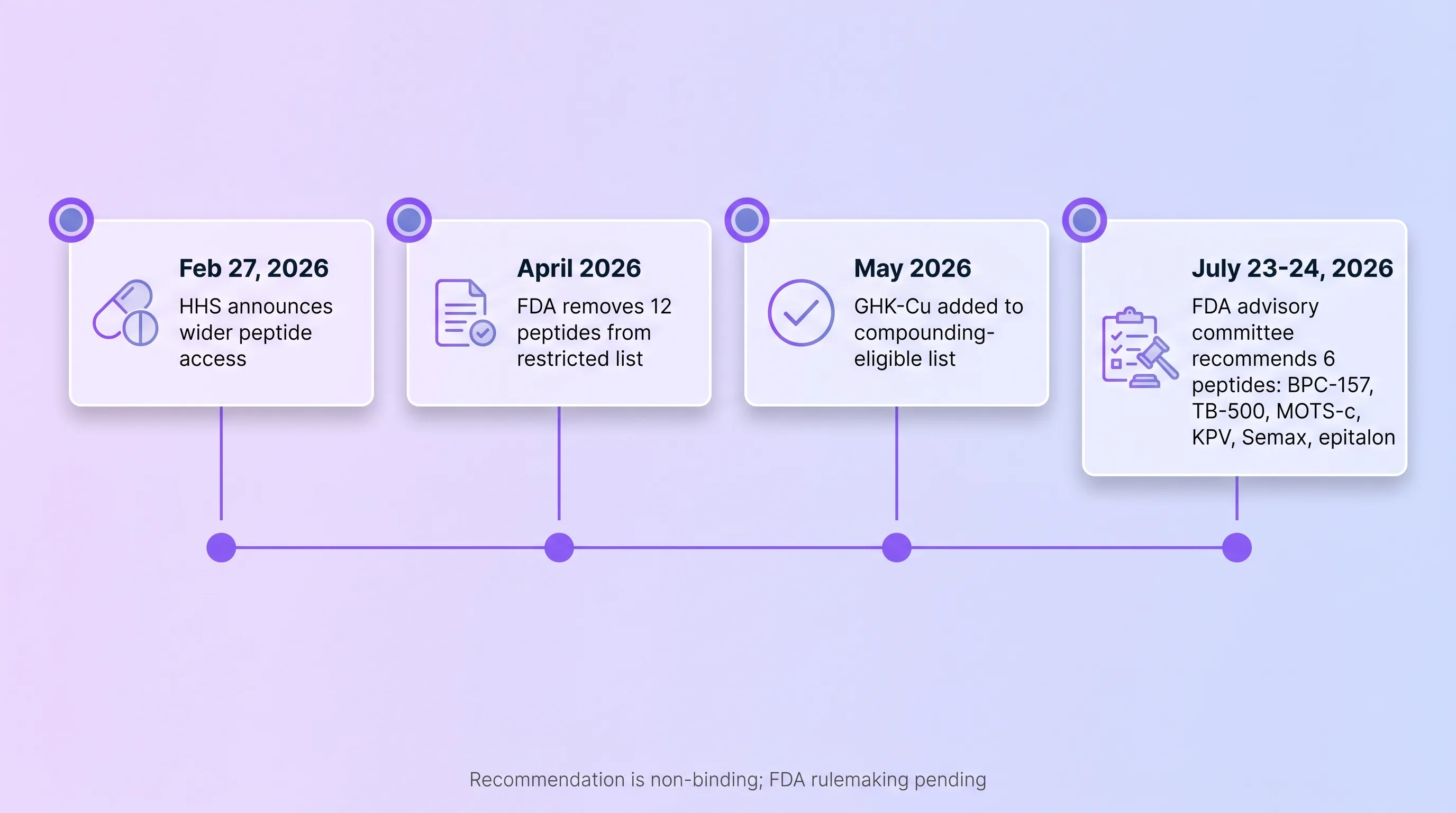
The 2026 peptide vote didn't happen in isolation — it's the latest step in a year of shifting FDA and HHS positioning on compounded peptides.
| Date | What happened |
|---|---|
| Feb 27, 2026 | HHS Secretary Robert F. Kennedy Jr. announced that roughly 14 of 19 restricted peptides would become available again through licensed compounding pharmacies — an access announcement, not an FDA approval |
| April 2026 | FDA removed 12 peptides from the restricted "Category 2" list, including BPC-157, TB-500, CJC-1295, ipamorelin, AOD-9604, GHK-Cu, and MOTS-c. Melanotan II, GHRP-2, GHRP-6, LL-37, and PEG-MGF remained restricted |
| May 2026 | FDA placed non-injectable GHK-Cu on the Category 1 list, meaning it may be compounded under enforcement discretion |
| June 30, 2026 | FDA staff briefing documents recommended against adding any of seven newly nominated peptides to the bulks list |
| July 23–24, 2026 | The PCAC voted, against staff advice, to recommend six of those seven peptides — BPC-157, KPV, TB-500, MOTS-c, epitalon, and Semax — for the 503A bulks list |
What comes next is rulemaking, not immediate change. The recommendation is non-binding — the FDA must still complete notice-and-comment rulemaking, including a proposed rule and public comment period, before any final rule takes effect. The FDA reported receiving more than 2,000 public comments on this round alone, and observers expect a final rule sometime in 2027 or 2028. A second PCAC meeting covering five more peptides is already scheduled for February 2027.
"Recommended for Compounding" Is Not "FDA-Approved"
A peptide recommended for the compounding bulks list is not the same thing as an FDA-approved drug — the two are governed by entirely different processes with different evidence standards. Understanding the distinction is the single most useful thing to take away from this vote.
FDA approval means a drug has gone through the full new-drug pathway: controlled clinical trials, a formal risk-benefit review, and an approved label with defined doses and indications. Compounding is different. Under Section 503A of the FD&C Act, a licensed compounding pharmacy can prepare a customized medication for an individual patient, based on a provider's prescription, using an ingredient on the FDA's 503A bulk drug substances list — but that ingredient itself has not been proven safe and effective the way an approved drug has.
The FDA sorts nominated substances into two categories:
- Category 1 — substances without significant safety signals identified so far; may be compounded under enforcement discretion while formal review continues.
- Category 2 — substances the FDA has flagged as potentially presenting significant safety risks; compounding is restricted or prohibited.
The July 2026 vote recommends moving BPC-157, KPV, TB-500, MOTS-c, epitalon, and Semax toward eligibility on the Category 1 bulks list — but until the rulemaking process finishes, that eligibility isn't final, and none of these six is an FDA-approved medication. That's also very different from the unregulated "research use only" peptides sold online, which fall outside this process entirely and aren't affected by any of it.
What the Research and Real-World Experience Show
Here's how BPC-157, TB-500, and MOTS-c actually stack up: each has a plausible, well-studied mechanism in animal research, a growing base of patient-reported experience at clinics that offer them, and human clinical trials that are still catching up to that real-world use.
BPC-157 is most often discussed for gut healing and tissue repair. Animal studies going back to the 1990s show it supporting the healing of the gut lining, tendons, and ligaments, and it was originally studied in a small human ulcerative colitis trial. Patients using compounded BPC-157 commonly report faster recovery from soft-tissue injuries and reduced gut discomfort, and clinics that have offered it over the past year describe it as one of their more requested peptides for recovery support. Large-scale human trials are still catching up to that anecdotal picture, which is part of why ongoing monitoring matters.
TB-500 is studied for its role in cell migration and wound healing, with a similar animal-to-clinic pattern: strong preclinical signal, and patients who use it commonly report quicker recovery after injury or intense training alongside BPC-157. As with BPC-157, larger human trials are still in progress.
MOTS-c is a mitochondrial-derived peptide studied for its role in metabolic health, insulin sensitivity, and bone density. Patients exploring it for metabolic or body-composition goals commonly report noticing changes in energy and workout recovery over several weeks. It's a newer addition to compounding pharmacies' offerings, so the clinical trial base is still smaller than for better-established options like FDA-approved GLP-1 medications.
What Idaho Patients Can Do Now
Right now, a nurse practitioner can prescribe a peptide sourced through a licensed compounding pharmacy after a real evaluation — labs, health history, and a conversation about what the evidence does and doesn't show. That standard hasn't changed because of the July vote; it's the same process that's applied since the April 2026 category changes.
At our clinics in Meridian, Twin Falls, and Lewiston, a peptide therapy consultation starts with lab work, not a prescription on request. If a peptide fits your goals and health history, it's sourced through a licensed pharmacy with a monitoring plan — never an unregulated online seller.
A few things worth knowing:
- What to avoid: research-chemical or "research use only" peptides sold online. These aren't regulated, aren't affected by the FDA's compounding process, and carry real safety unknowns.
- What stays the standard for weight loss: FDA-approved GLP-1 medications remain the proven category for medically supervised weight loss. Peptides like MOTS-c are being studied for metabolic and body-composition goals, but they aren't a substitute for that established evidence base.
- Where BPC-157 and TB-500 fit today: as informational, off-label options discussed candidly at a consultation — see our BPC-157 and TB-500 guides, or browse the full peptide guide index for what's currently understood about each one.
What patients tell us: Patients who come in asking about BPC-157, TB-500, or MOTS-c are usually looking for help with a lingering injury, slow recovery between workouts, or stalled metabolic goals. The patients we see who stay on a monitored peptide plan commonly report feeling that recovery difference within the first several weeks — though, as with any therapy, results vary and a peptide is only started after labs confirm it's a reasonable fit.
What to Watch Next
The next real milestone is the FDA's proposed rule, which opens a formal public comment period — that's the stage where this recommendation could still change. A second PCAC meeting covering five more nominated peptides is scheduled for February 2027, with a final rule on this round not expected until 2027 or 2028. We'll keep tracking the FDA's 503A bulk drug substances program page and update our peptide guides as rulemaking moves forward.
Frequently Asked Questions
Is BPC-157 FDA-approved now?
BPC-157 moved a big step closer to routine compounding access in 2026: the FDA removed it from its restricted list in April, and on July 23 an FDA advisory committee recommended adding it to the 503A compounding list. That recommendation is different from drug approval. BPC-157 remains an unapproved compound that a licensed pharmacy may prepare for an individual patient by prescription once the final rule is in place, and where a pharmacy is comfortable doing so today. A nurse practitioner confirms what applies on the day you start.
Are peptides legal in Idaho?
Peptides prescribed by a licensed provider and prepared by a licensed compounding pharmacy are legal to use in Idaho under the same framework that applies nationally. Peptides purchased from unregulated online "research use only" sellers fall outside that framework and carry real safety and quality risks.
Can I get BPC-157 in Boise or Meridian?
Boise-area patients are seen at our Meridian clinic, where a nurse practitioner can evaluate whether BPC-157 or another peptide fits your specific health history and goals. Access depends on an individual consultation and sourcing through a licensed compounding pharmacy, not a walk-in prescription.
Is the July 2026 vote final?
No. The PCAC's recommendation is non-binding. The FDA must complete notice-and-comment rulemaking — including a proposed rule and public comment period — before any of the six recommended peptides gains formal bulks-list status, a process expected to run into 2027 or 2028.
Are online peptides the same as what a clinic offers?
No. Peptides sold online as "research chemicals" are unregulated, unmonitored, and not affected by the FDA's compounding process at all. Peptides prescribed through a licensed provider are sourced from licensed compounding pharmacies with quality and monitoring standards that unregulated sellers don't meet.
The Bottom Line
The 2026 peptide vote is a meaningful step toward broader, more consistent compounding access for peptides like BPC-157, TB-500, and MOTS-c — it's a recommendation rather than a final approval, and clinical research is still catching up to what patients and providers are already seeing in practice. FDA-approved GLP-1 medications remain the proven option for weight loss, and peptide use works best as part of a monitored plan with a qualified provider. If you're curious whether peptide therapy fits your goals, book a consultation with our team in Meridian, Twin Falls, or Lewiston to talk through what's changed and what's right for you.


