Peptides for Weight Loss: What Actually Works
By Bryce Johnson ·

Peptides for weight loss fall into two very different categories: FDA-approved GLP-1 medications like semaglutide and tirzepatide, which have strong clinical trial evidence behind them, and a separate group of off-label research peptides with far less human data. Knowing which is which matters, because the safety profile, evidence base, and legal status are not the same. Below, we break down what's actually proven, what's still experimental, and what a real consultation looks like at our Idaho clinics in Meridian, Twin Falls, and Lewiston.
What Are Peptides, and How Are They Different From GLP-1 Medications?
Peptides are short chains of amino acids that act as signaling molecules in the body — think of them as messengers that tell cells what to do. GLP-1 medications like semaglutide and tirzepatide are technically peptides too, but they've gone through the full FDA approval process, with large randomized trials proving they help people lose weight safely under medical supervision.
Other peptides sometimes marketed for weight loss or body composition — such as Tesamorelin, CJC-1295, Ipamorelin, AOD-9604, and MOTS-c — have not gone through that same process for weight loss. They may be used off-label by clinicians, sourced through licensed compounding pharmacies, but the human evidence supporting them is much thinner. Understanding this split is the single most important thing to know before considering peptide therapy for weight loss.
GLP-1 Peptides for Weight Loss — Semaglutide and Tirzepatide
The proven category of peptides for weight loss is GLP-1 receptor agonists, and the clinical data here is substantial. Semaglutide (FDA-approved as Wegovy) and tirzepatide (FDA-approved as Zepbound) are the two GLP-1 peptides with the strongest track record for chronic weight management.
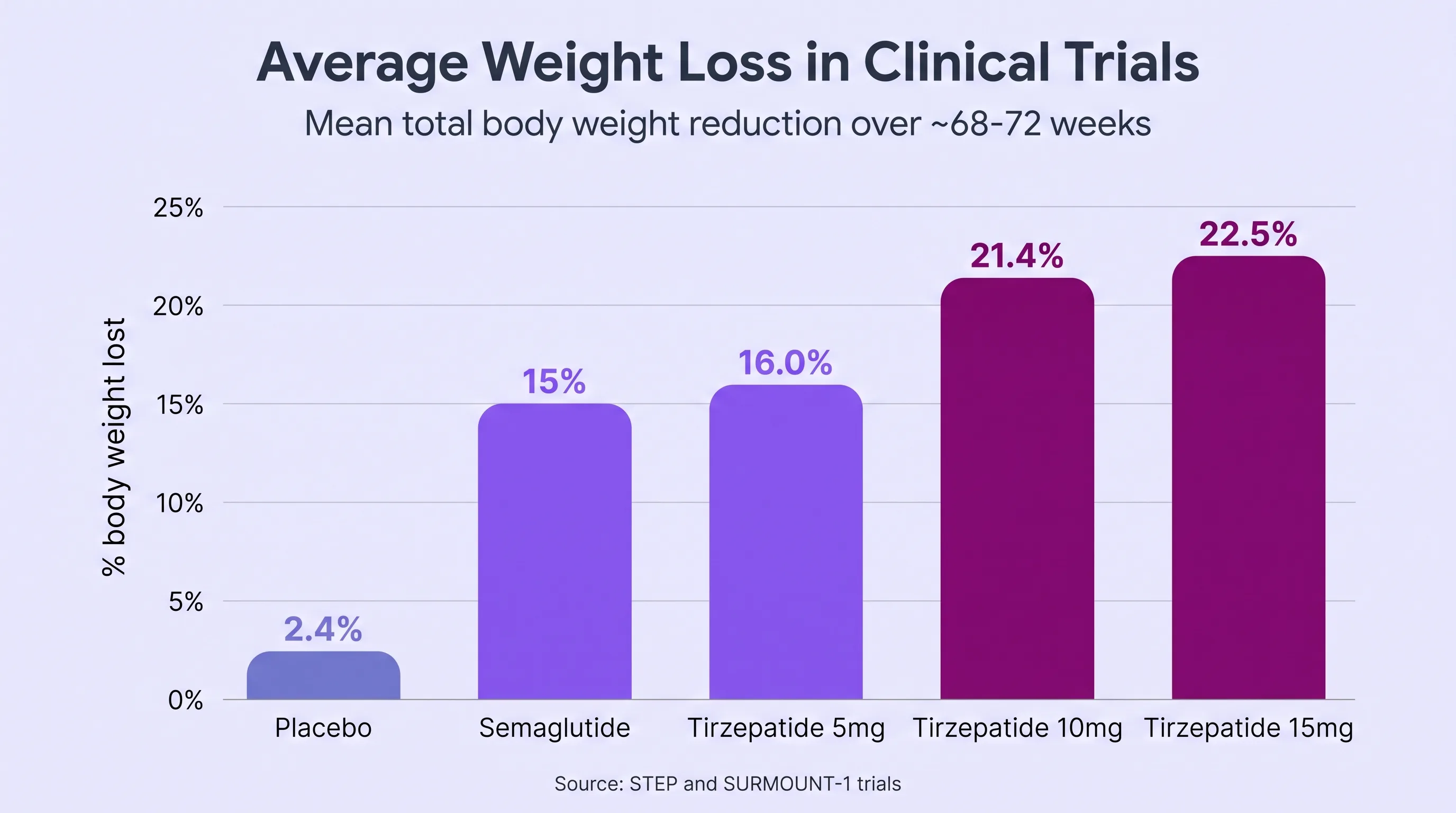
In the STEP trial program, participants taking semaglutide lost an average of roughly 15% of their body weight over about 68 weeks, compared to modest loss in the placebo group. Tirzepatide performed even more strongly in the SURMOUNT-1 trial, where participants lost an average of 16.0% of body weight at the 5mg dose, 21.4% at 10mg, and 22.5% at 15mg over 72 weeks, versus only 2.4% in the placebo group. A later head-to-head, SURMOUNT-5, found tirzepatide outperformed semaglutide directly, with 20.2% average weight loss versus 13.7% at 72 weeks.
These GLP-1 peptides work by slowing digestion, reducing appetite, and improving how the body regulates blood sugar — but they work best as part of a structured, medically supervised weight loss program that includes lab monitoring, nutrition guidance, and dose titration by a qualified provider. GLP-1 peptides for weight loss are not a standalone fix; results depend heavily on the surrounding program and consistent follow-up.
GLP-1s vs. Other Weight-Loss Peptides — Know the Difference
The clearest way to understand peptides for weight loss is to compare the two categories side by side. One has robust, large-scale trial data and FDA approval; the other is used off-label with far less human research behind it.
| Factor | GLP-1 Peptides (Semaglutide, Tirzepatide) | Other Peptides (Tesamorelin, CJC-1295/Ipamorelin, AOD-9604, MOTS-c) |
|---|---|---|
| FDA status | FDA-approved for chronic weight management (Wegovy, Zepbound) | Not FDA-approved for weight loss; Tesamorelin approved only for HIV-associated lipodystrophy |
| Evidence base | Large randomized controlled trials (STEP, SURMOUNT) | Limited or emerging human evidence; mostly small studies |
| Use category | First-line, standard of care | Off-label, used selectively by clinicians |
| Sourcing | Manufactured pharmaceutical product | Compounded through licensed pharmacies |
| Typical goal | Meaningful, sustained body weight reduction | Body composition, visceral fat, or lean mass support |
If your primary goal is weight loss with the strongest evidence behind it, GLP-1 peptides are the category with proof. The other peptides in this table are discussed below for informational purposes, but they are not a substitute for GLP-1 therapy.

Other Peptides Sometimes Discussed for Body Composition
Beyond GLP-1s, a handful of other peptides come up in conversations about body composition — but each one is used off-label, sourced through licensed compounding pharmacies, and backed by limited or preliminary human research rather than large trials.
- Tesamorelin has been studied for reducing visceral fat and is FDA-approved specifically for HIV-associated lipodystrophy — not for general weight loss. Because it stimulates the growth hormone axis, it carries an honest caution around cell-replication and cancer risk that should be discussed directly with a provider before use.
- CJC-1295 and Ipamorelin are growth hormone-releasing peptides studied primarily for their effects on growth hormone release and lean muscle mass, not fat loss directly.
- AOD-9604 has early-stage research exploring its role in fat metabolism, but evidence in humans remains limited.
- MOTS-c is a mitochondrial-derived peptide with preliminary metabolic research; it is not an established weight-loss treatment.
None of these peptides for weight loss should be purchased from unregulated online sellers. Any use of off-label peptides should happen only through a licensed compounding pharmacy and under the guidance of a clinician who can monitor your response and adjust course.
Safety and Side Effects of Peptides for Weight Loss
The most common peptides for weight loss side effects with GLP-1 medications are gastrointestinal — nausea, constipation, and occasional diarrhea, especially during dose increases. These usually ease over time as the body adjusts and the dose is titrated slowly. Less common but more serious risks include pancreatitis and gallbladder issues, which is why lab work and ongoing monitoring matter.
A bigger safety concern involves peptides purchased outside a licensed clinical setting. The FDA has issued warnings about unapproved GLP-1 drugs sold online, and separately about dosing errors linked to compounded semaglutide that have led to hospitalizations. Research also documents the GI and pancreatitis-related safety profile of semaglutide in more detail. The takeaway: peptides for weight loss should always come from a licensed pharmacy and be monitored by a qualified clinician, never from an unregulated source promising a shortcut.
What Results and Timelines Actually Look Like
Realistic expectations matter with any peptide therapy for weight loss. In clinical trials, semaglutide produced roughly 15% average body weight loss and tirzepatide produced 16–22.5% depending on dose, both measured around 68–72 weeks — not overnight, and not without a structured program behind it.
Individual results vary based on starting weight, dose, adherence, diet, activity level, and how your body responds. These numbers come from controlled trials with regular follow-up and support; results outside that structure are typically lower. Any discussion of expected weight loss should be paired with a provider evaluation of your specific health history, since results are never guaranteed.
What to Expect at a Peptide Therapy Consultation in Idaho
A peptide therapy consultation starts with lab work and a full health history review, not a prescription handed over on request. Our nurse practitioners use that information to screen for candidacy, check for contraindications, and build an individualized plan rather than a one-size-fits-all protocol.
If GLP-1 therapy is appropriate, medication is sourced through licensed pharmacies with clear dosing guidance and a monitoring schedule. If other peptides are being considered for specific, off-label goals, that conversation includes a candid look at the limited evidence and realistic expectations. Follow-up visits track progress, side effects, and any dose adjustments — clinician-guided care from start to finish, not a set-and-forget program.
Frequently Asked Questions
What are peptides for weight loss and how do they work?
Peptides for weight loss are short amino acid chains that signal the body to regulate appetite, digestion, or metabolism. GLP-1 peptides like semaglutide and tirzepatide slow digestion and reduce appetite, while other peptides target different pathways like growth hormone release or fat metabolism with much less supporting evidence.
What's the difference between GLP-1 peptides and other weight-loss peptides?
GLP-1 peptides (semaglutide, tirzepatide) are FDA-approved for chronic weight management and backed by large randomized trials. Other peptides discussed for body composition, like Tesamorelin or CJC-1295/Ipamorelin, are used off-label, sourced through compounding pharmacies, and supported by far more limited human research.
What are the side effects of peptides for weight loss?
The most common peptides for weight loss side effects with GLP-1 medications are nausea, constipation, and digestive upset, particularly during dose changes. Less common but more serious risks include pancreatitis and gallbladder problems, which is why lab monitoring and clinician oversight matter throughout treatment.
Are peptides for weight loss safe, and are they FDA-approved?
Semaglutide (Wegovy) and tirzepatide (Zepbound) are FDA-approved for chronic weight management and considered safe when prescribed and monitored by a clinician. Other peptides are not FDA-approved for weight loss, carry more safety uncertainty, and should only be used off-label through a licensed compounding pharmacy under medical supervision.
How much weight can you realistically lose with peptide therapy?
In clinical trials, semaglutide produced about 15% average body weight loss and tirzepatide produced 16–22.5% depending on dose, both over roughly 68–72 weeks. Individual results vary and depend on adherence, starting health, and participation in a full, provider-guided program.
What should I expect at my first peptide therapy consultation?
Expect lab work, a detailed health history review, and a candidacy screening by a nurse practitioner before any treatment begins. From there, you'll get an individualized plan sourced through licensed pharmacies, with follow-up visits to monitor progress and adjust as needed.
Next Steps
Peptides for weight loss offer real, evidence-backed options — but the right choice depends on your health history, goals, and candidacy, not a one-size-fits-all protocol. Our nurse practitioners in Meridian, Twin Falls, and Lewiston, Idaho can walk you through what's proven, what's off-label, and what makes sense for you. Not sure where you stand? Try our hormone and weight loss assessment quiz, or go ahead and Book a Consultation to get started.